
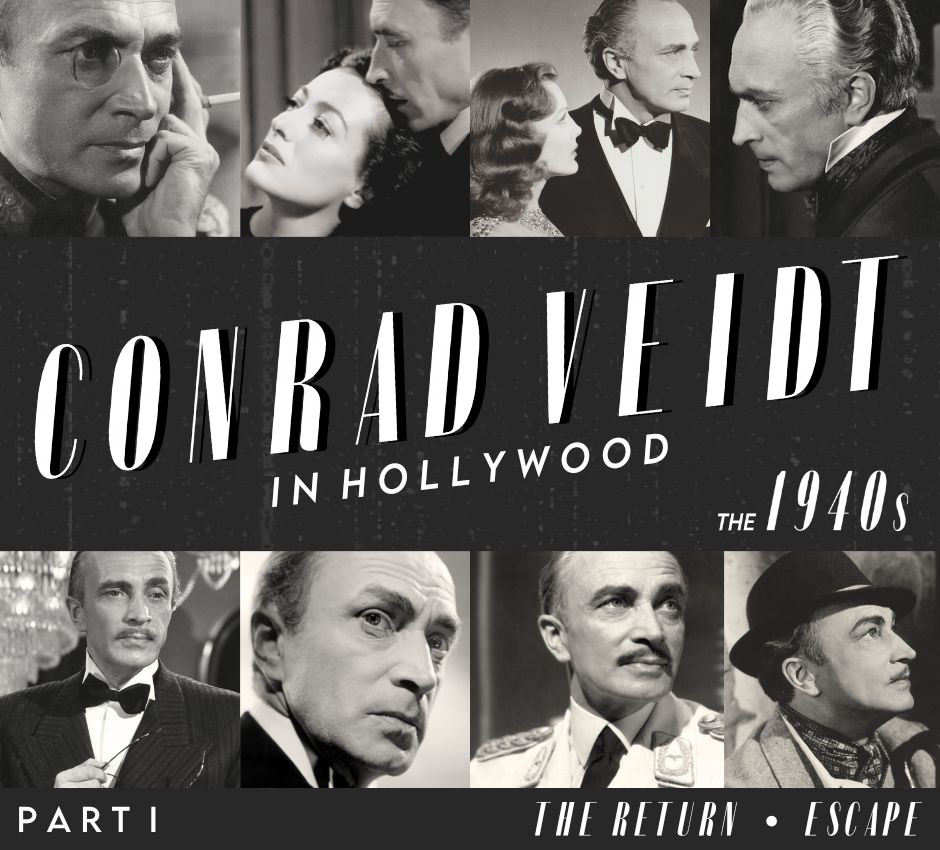
In the spring of 1940, Conrad Veidt and his wife Lily traveled from England to America to promote and distribute his new film with Powell and Pressburger, Contraband. This was during a critical time in Great Britain's fight against Germany, and the film was thought to be a perfect opportunity to increase American support for the British war effort. The isolationist United States was still a neutral power in 1940, and the UK could use all the help it could get.
But no sooner had Connie and Lily arrived in New York than Hollywood came calling. There's a role opening up in MGM's new picture with Norma Shearer and Robert Taylor, they said. The actor we originally cast as the villain isn't scary enough! Would you be interested in the part? they said. Oh, and by the way… the character is a Nazi general.
It's not a stretch to assume that Veidt would have felt conflicted about this offer. On the one hand, MGM's Louis B. Mayer was requesting Veidt specifically, and the opportunity could have led to a long-term contract with the most prestigious studio in Hollywood. But conversely, being asked to play a Nazi must have been disappointing, to say the least, to such an established and versatile performer as Veidt who was a fervent anti-fascist. Connie had never been cast in a role like this. He had played many villains across his storied career, but never a Nazi.
So what would possess him to agree to this?
The offer would certainly mean more money, but a hefty paycheck wasn't really important to Connie personally. However, because he was donating the bulk of his salary to support England's war relief, perhaps he was thinking about the various scenarios in which he could do the most good for the most people. And maybe that meant doing something symbolic in addition to practical financial support. It's possible he thought that, by accepting this role and any future roles like it, he could help make American audiences see how much of a problem the Nazis were, something he had first-hand experience with.
Regardless, going after Veidt was a smart move on MGM's part. Connie was a huge box office draw in the UK, a headliner, often receiving top billing. So MGM literally snapped him up the second he set foot back on American soil.
But once they had him, it's like they didn't know what to do with him.
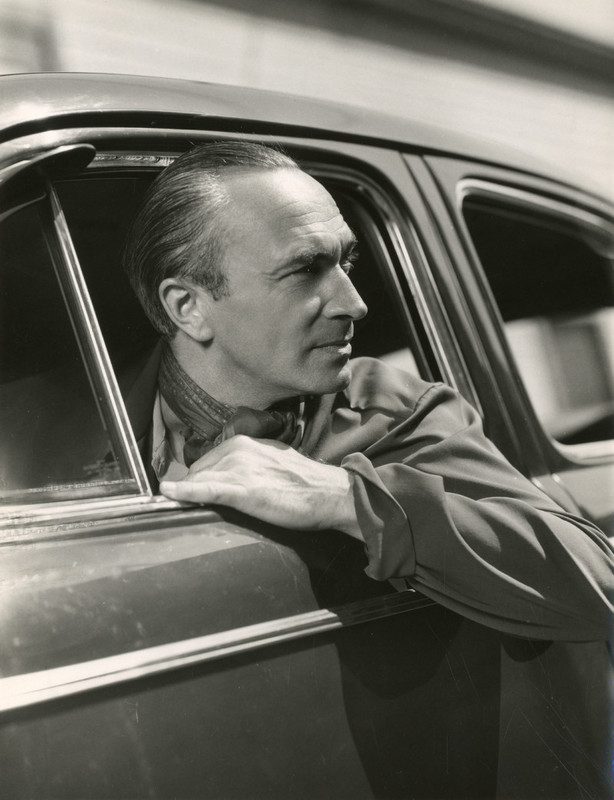 |
| Conrad Veidt, 1940, by Clarence Sinclair Bull |
Welcome to the first of a series of posts about Conrad Veidt's work in the United States between 1940 - 1943. I've been wanting to write about this particular part of Connie's career for a while, mainly because there is an underlying sense that the way Hollywood treated him in this period was one of the factors that contributed to his lack of a broader legacy in film history compared to his peers.
Veidt's return to Hollywood was sadly cut short by his sudden death in 1943, but in that time he made eight very different films under the fabled American studio system: Escape, A Woman's Face, Whistling in the Dark, The Men in Her Life, All Through the Night, Nazi Agent, Casablanca, and Above Suspicion. These titles make up the bulk of Veidt's films that one might occasionally encounter on the Turner Classic Movie channel, some of which are better than others for sure.
In only one of these late career films Veidt was allowed to play the heroic lead. Between 1940 - 1943, his Hollywood contract saw him typecast as six villains, four of which, unfortunately, were Nazis. And none of these roles were close to approximations of romantic leads or love interests as a number of the parts he'd played in the UK in the '30s had been. Regardless, Conrad Veidt infused his 1940s Hollywood roles with complex and subtle, at times verging on subversive, sexuality. The notable exception was of course when it came to his portrayal of Nazi antagonists in All Through the Night, Nazi Agent, and Casablanca.
But Hollywood was uninterested in offering Connie any parts that were particularly challenging. His most memorable roles during this era are the ones he made work through sheer force of will.
---
In the decade since Veidt first worked in Hollywood, the American film industry had expanded tenfold. Sound recording technology was introduced to moviemaking in the late 1920s and has been the primary reason cited for Connie's return to Germany in 1929, although the fact was that Connie had struggled to find suitable roles during his first trip to California at the end of the silent era. But Hollywood had changed in other ways in the intervening years. The 1929 Wall Street crash and the ensuing depression that devastated the American economy caused the closures of thousands of cinemas nationwide. Major studios declared bankruptcy and film workers' salaries were slashed to protect the executives. But the hard times of the 1930s only fueled the opulence and untouchability of the Hollywood dream factory.
The Hollywood that Conrad Veidt returned to in 1940 had also been reshaped by the Motion Picture Production Code. Also known as the Hays Code, this was a stricter form of censorship designed by the studios in collaboration with Postmaster General, Will Hays, to appeal to various conservative and evangelical groups across the US. I'll be delving more into The Hays Code in a future post.
But those years of tragedy and upheaval and meddling had changed Hollywood in ways that would affect the industry for decades to come. And by 1940, Conrad Veidt had changed too. The German silent film star of the '20s spent the 1930s honing his craft. The advent of sound in film finally allowed him to use one of the most powerful tools in his arsenal: his voice. He mastered the English language, finding unique ways to make it work for him from film to film. In his personal life there were struggles as well as moments of joy. He and his third wife Lily fled the Nazi regime, landing on their feet in England where they eventually became British citizens. In some ways, it could be argued that the 1930s forced Conrad Veidt to grow up. On screen, he evolved from his demonic German Expressionist persona into a sophisticated continental gentleman. He made costume dramas, war pictures, bio pics, and spy thrillers. His performances, each finely tuned to suit each film, showcased variety rather than being limited by a certain type. By 1940, Connie was 47 years old and his new homeland was at war with the country of his birth.
---
.png) |
| Escape Half Sheet, via IMDB |
Escape (1940)
It's 1936. An American man searches for his estranged mother in the Bavarian Alps where he believes she is being held prisoner in a concentration camp. The mother is gravely ill, and of course the man, Mark Preysing, struggles against all the road blocks and obfuscation set in place by the Nazis and the complicit/terrified locals. Along the way, Preysing meets fellow American, Ruby, a wealthy widow, and they fall in love almost immediately. Ruby runs a girls' finishing school and is in a toxic relationship with a Nazi general, Kurt von Kolb, who is way more interested in climbing the party ladder than he is in her. Eventually Preysing is able to locate and extricate his mother from the camp, and hides her at Ruby's while securing papers and safe transport out of Germany. General Kolb tries to intimidate Preysing and Ruby into revealing their secrets, but he's beaten by his real adversary, his terminal illness. Mark and his mother escape (hey, that's the name of the movie), but Ruby elects to stay behind with the dying general.
Escape, Connie's first Hollywood film in over a decade, isn't a particularly good film. It clearly has the aspirations of being a Hitchcockian thriller, and in fact Hitchcock was slated to direct the picture but turned the project down. It's not exactly a bad movie, but it falls flat in almost every aspect, from the script to the performances to the editing and beyond. However, it is the film that brought Connie back to Hollywood after many years spent essentially rebranding himself and his career.
Now it was 1940, and Connie was coming from England where the war was so much closer and so much more real than it was in America before Pearl Harbor. Connie refused to accept the role of the Nazi general in Escape until he made absolutely sure whatever money he made on the film would officially go to war relief funds in Great Britain. That was genuinely all that mattered to him.
Directed (mostly) by Mervyn LeRoy, Escape was received well at the time but is largely forgotten today, a mere footnote in the careers of its stars. The two leads, Norma Shearer and Robert Taylor, are serviceable. Shearer is decent as Countess Ruby von Treck, the widow of a German aristocrat. Her best scene by far is at the end of the film when she finally lets out some of her rage (see video below, skip to 0:59). But poor Robert Taylor is just so painfully the generic Hollywood leading man as Mark Preysing. The film also stars queer Russian-American actress Alla Nazimova as Preysing's mother, who hardly has anything to do in the film except be an invalid. Bafflingly, even with big, glamorous movie stars like Shearer and Taylor in the cast, audiences responded most to Connie's performance as General Kurt von Kolb. They positively ate it up.
Kolb, in addition to being a literal Nazi, is genuinely awful to Ruby. He's possessive, manipulative, and super scary in a way that makes me as a viewer today deeply uncomfortable. That said, Connie is without exaggeration the best thing in the film, and it's because of this role that he received his singular acting award when the National Board of Review named him among the winners in their Best Acting category in 1940.
As soon as Escape hit theaters, the letters from fans came pouring in. Connie, a 47 year old German-British emigree, was getting as much fan mail as the biggest leading stars of the day, and all because of this particular performance. In retrospect, Kolb could perhaps be seen as a somewhat sympathetic character. His illness makes him fragile and therefore perhaps somewhat vulnerable. The general American population in 1940 didn't have all the facts about the extent of the Nazis' various atrocities, so it was easier for them to see Kurt von Kolb as just another screen villain for them to objectify rather than a representative of people who were committing crimes against humanity.
In the film, where all the Bavarian locals magically speak English, General Kurt von Kolb is essentially a bureaucrat like Connie's other later Nazi characters. He is seemingly entirely committed to his party and his country above all else. The major difference with this role compared to the others like Major Strasser (Casablanca), etc. is that we get to see some of Kolb's personal life, and because of that we are able to piece together that he's also very likely an abuser. He never raises a hand to Ruby, but he doesn't have to. On the surface he seems like a gentleman, but the more we see the couple together, the more his silky line delivery turns to poison. He'll purr at Ruby, but then suddenly snap at her, revealing his ugliness for just a fraction of a second. Kolb doesn't care about her, not really, but like some abusers he can’t bring himself to discard her either. And she bends too easily to the way he uses his illness as an excuse to manipulate her. He gets off on playing with her; the way his forehead vein is poppin' out when he says to Ruby, "I can't resist the impulse to tease you," is such a dead giveaway. He keeps telling Ruby that she's tired, over and over, making her believe she's more fragile than she really is. It's so awful to watch. He's so completely in control of their relationship without ever being physically violent.
There's a scene well into the film where he's on the phone with Ruby, and by this point his mask of civility is starting to slip. When the camera cuts to him, although there's a smile on his face, there's nothing but contempt in his eyes. I don't know if Kolb is just a soulless cog in the Nazi machine, I don't know if he's a sociopath, but I do think he's a dick.
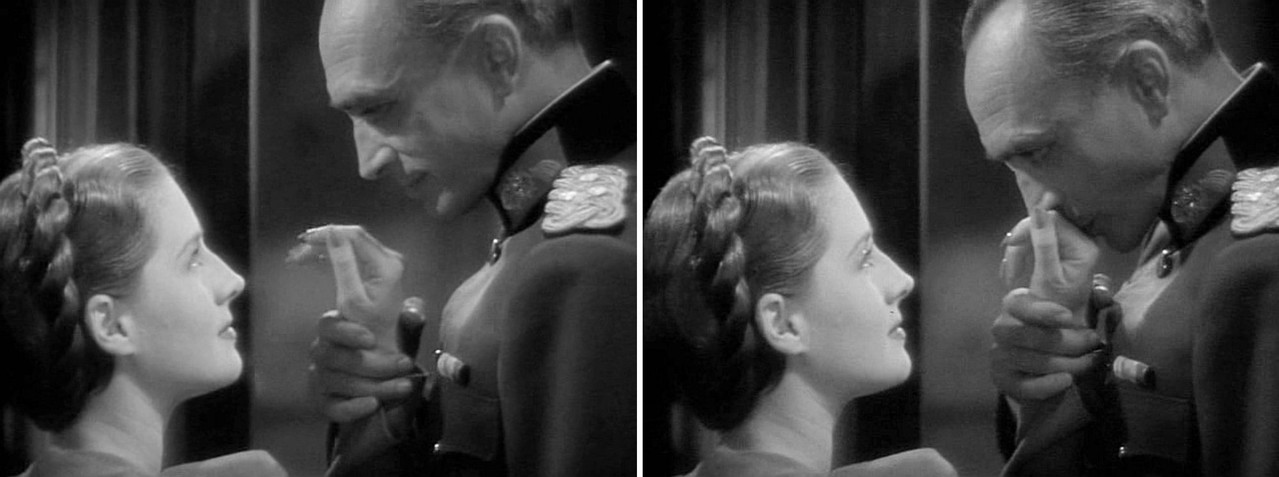 |
| Norma Shearer and Conrad Veidt |
Another uncomfortable dynamic in the film is Kolb's relationship with Ruby's students. This handful of teenage girls are pretty much all obsessed with him, all for entirely superficial reasons. They sit and listen to his stories with rapt attention, hanging on his every word. And Kolb clearly loves it, he loves playing the charming older military man, openly flirting with them in front of Ruby who does not seem to care. But it’s all part of Kolb's manipulation of everyone in his life, at least that we get to see. The only authentic thing about this character is his desire for control -- in his relationships, in his position, in any given situation or interaction -- in the face of being completely at the mercy of the ticking time bomb of his illness.
As the film draws to its conclusion, his false friendliness is even more obvious. The way he says to Ruby, almost off hand but with so much acidic cruelty, "You shouldn't wear that dress, it washes you out, you look like a ghost," not even looking at her, and in front of Robert Taylor, is so uncalled for and so nasty. But it is a power move, Connie is asserting the character's dominance through line delivery and subtle physicality. He does this again shortly afterward when he blocks Taylor's exit from a different scene. He gets in the hero's personal space only to say in honeyed and queer-coded tones, "I don’t like you, Mr. Preysing."
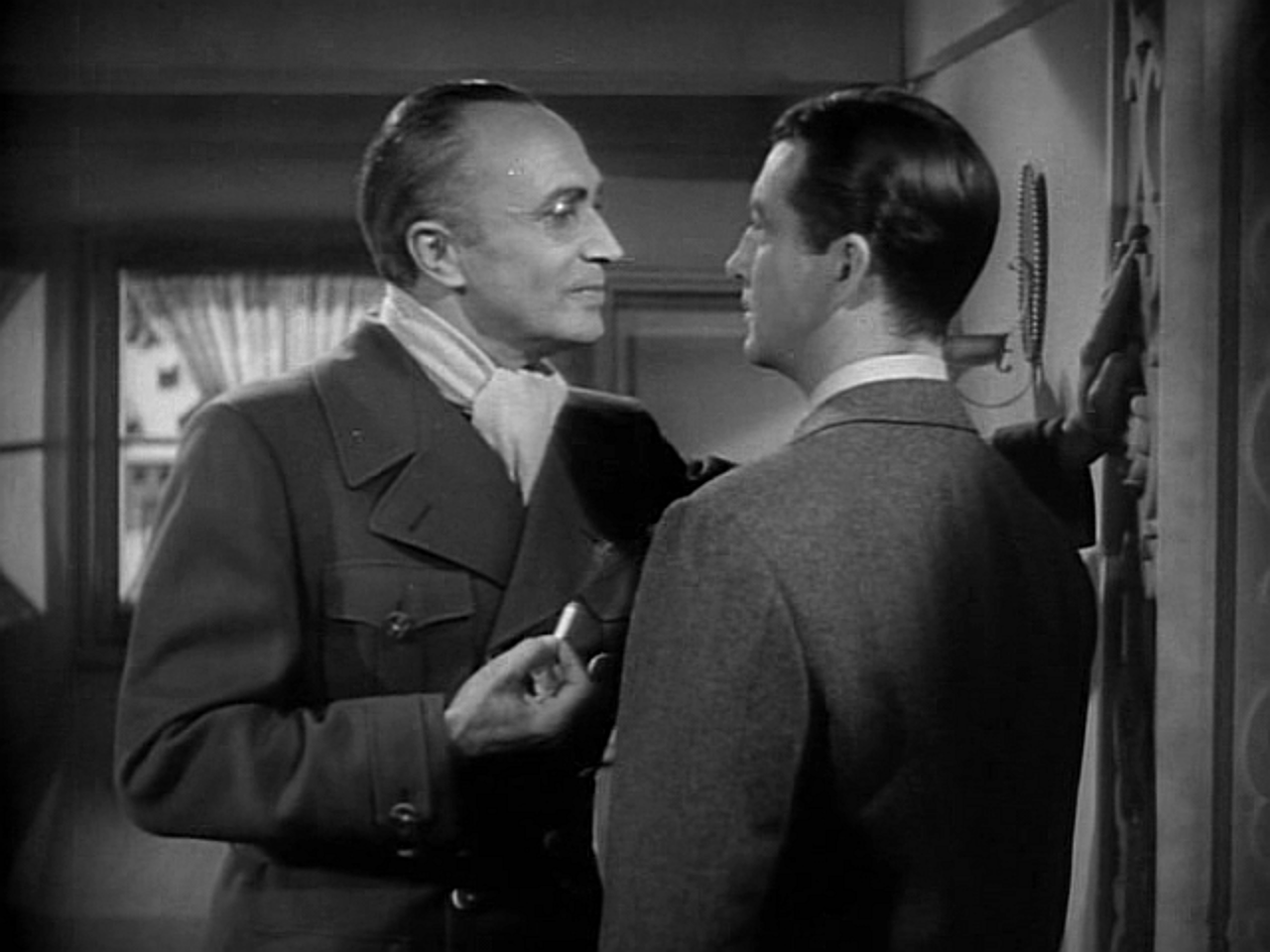 |
| Conrad Veidt and Robert Taylor |
All of these superbly executed choices add up to him being recognized for that National Board of Review award. Not for the first time and certainly not the last, Connie is acting circles around his co-stars. He's doing so much more interesting, slight, subtle and nuanced technical stuff as an actor than hardly anyone, especially most male movie stars, was doing in 1940.
Kolb is, without a doubt, Connie's scariest screen villain. The combination of verbal and emotional abuse on top of being a dyed in the wool card-carrying member of the Nazi party, makes him The Worst. So naturally, this performance raises a lot of questions.
Is Connie's nuanced portrayal of Kolb due to the writing? The directing? The editing? Was he just using this film to get his sea legs back in Hollywood? Was it due to rushing into a role he didn't have adequate time to prepare for because he was called in as a last minute replacement? Did he want to make sure he did a good enough job so he could extend his contract? Was it because it had been some years since he'd played someone truly awful?
In an LA Times article from December 1940, Connie was quoted as saying, "If, in playing a bad man, the actor can show that man has somewhere in him a human corner, you make him real. That is how I get away with my villains! The General, I think, has something of the old German tradition of decency and honor. He is a soldier and must do his duty; but how much, I try to make my audiences ask themselves, does he believe in the new regime?"
I understand where he was coming from, from an acting perspective, wanting to deliver a multi-dimensional performance. But was this an irresponsible choice? Especially for someone who had endured detainment and interrogation by the Nazis, someone whose wife would have almost certainly been put in a concentration camp? (Escape notably doesn't address whether the main character or his mother are Jewish, but it can definitely be inferred by the audience.) Connie was an optimistic humanist who tried not to paint other people as all good or all bad. We can see this in all of his on-screen work. He wanted to make these characters feel real. What might be unspoken in that LA Times quote is the choice to see humanity in these truly villainous characters was a technique he used to get through each day's filming. Playing bad men like Kolb can be extremely emotionally taxing, but actors in the 1940s weren't super transparent about how challenging their work was, they had to maintain the glamor of Hollywood at all costs.
Personally, I don't read Kolb as sympathetic. I do think he's fully sold his soul to tow the party line, but that's almost irrelevant because Kolb is an abusive, manipulative asshole. The only sense of traditional decency and honor in him has been warped by a taste for cruelty. Deep into the film, Kolb is compared to a tarantula. Tarantulas are nothing if not patient. But once their prey is in their sights, they strike with force and speed. And that's what Kolb does with every toxic, venomous remark. Because of his weak heart, he's not able to brutalize his enemies and the people who betray him, but he can and does poison them with his words. Maybe, if anything, there's an inkling of pity in my reception of Kolb. I'm definitely scared of him. I have no problem believing this guy is a total sadist, even though he brands himself as a bureaucrat.
I think Connie was asking a little too much of his audience with this performance, certainly for the time in which the film was released. The general American movie-going population was not ready for something this complicated and challenging, a character that, if you respond to him with curiosity or even desire, requires you to take a long, hard look at some extremely complex parts of your psyche. Regular people were not prepared for that. We can't ask Connie how he felt years later about how he chose to play Kolb, given what the world was to learn about what the Nazis were doing in the death camps. We can only look at what he did with his performances that came after.
Regardless of whatever stipulations may have been in his actual legal acting contracts, the Nazis that Connie played after Escape were different, stiffer. His vocal quality in these later roles became more clipped and business-like. Across the board, he made sure these men were cold and unapproachable. For the most part, there is no hint of a personal life or backstory in these future roles, and if there was Connie made a point to emphasize the character's cruelty. Strasser, Ebbing, and von Detner are utterly uninteresting and, on the whole, without charm. Whether or not this was a conscious decision, as I am inclined to believe it was, he made sure these future Nazi villains were as unappealing as humanly possible because, I think, he had a sense that he'd missed the mark in Escape, regardless of the praise he received.
Coming soon, Part 2: The Hays Code + A Woman's Face
---
RESOURCES:
- Conrad Veidt On Screen, John T. Soister
- "How the Great Depression Reshaped Hollywood Studios’ Ties With Workers", Eric Hoyt, The Hollywood Reporter, 19.03.2022
- "Will Hays and 'Pre-Code' Hollywood", Karina Longworth, You Must Remember This, 14.08.2018
- "Villain By Accident", Betty Harris, Modern Screen, 06.1941
- "Veidt Finds Excuse for General Role in 'Escape'", LA Times, 12.12.1940
No comments:
Post a Comment