Friday, April 3, 2026

Link: New Interview with Jim Rathlesberger

To commemorate the 83rd anniversary of Conrad Veidt's passing, there's a great new interview with the founder of the Conrad Veidt Society, Jim Rathlesberger, over on Monica Ilie-Prica's website. I highly encourage anyone interested in the history of the CVS and Veidt's legacy among various generations of fans to check it out. 

I would love to do a longer post about the Society one day, but Mr. Rathlesberger gives a fairly comprehensive account of the CVS's founding, its mission and activities in the interview. Since I first read about the Society in Conrad Veidt on Screen, I've wondered if there's a place for a more conventional, organized fan space dedicated to Connie. We're scattered across various platforms and cross communication is relatively infrequent, despite the ultra-connected internet age we live in. 

You can read Monica Ilie-Prica's interview with Jim Rathlesberger here.

And to celebrate Connie's life and work, go watch one of his films! There is a Youtube playlist and I just curated a list of several titles on the Internet Archive here as well.

Sunday, March 29, 2026

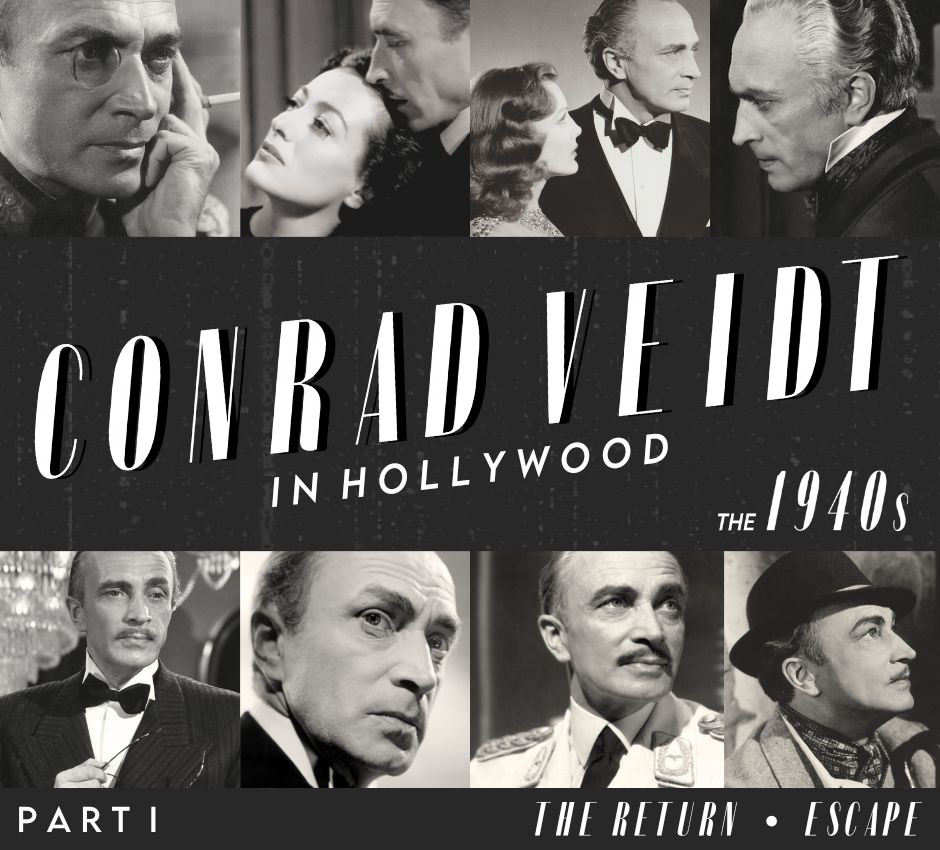
Veidt in Hollywood: The 1940s, Part I


In the spring of 1940, Conrad Veidt and his wife Lily traveled from England to America to promote and distribute his new film with Powell and Pressburger, Contraband. This was during a critical time in Great Britain's fight against Germany, and the film was thought to be a perfect opportunity to increase American support for the British war effort. The isolationist United States was still a neutral power in 1940, and the UK could use all the help it could get.

But no sooner had Connie and Lily arrived in New York than Hollywood came calling. There's a role opening up in MGM's new picture with Norma Shearer and Robert Taylor, they said. The actor we originally cast as the villain isn't scary enough! Would you be interested in the part? they said. Oh, and by the way… the character is a Nazi general.

It's not a stretch to assume that Veidt would have felt conflicted about this offer. On the one hand, MGM's Louis B. Mayer was requesting Veidt specifically, and the opportunity could have led to a long-term contract with the most prestigious studio in Hollywood. But conversely, being asked to play a Nazi must have been disappointing, to say the least, to such an established and versatile performer as Veidt who was a fervent anti-fascist. Connie had never been cast in a role like this. He had played many villains across his storied career, but never a Nazi. 

So what would possess him to agree to this?

The offer would certainly mean more money, but a hefty paycheck wasn't really important to Connie personally. However, because he was donating the bulk of his salary to support England's war relief, perhaps he was thinking about the various scenarios in which he could do the most good for the most people. And maybe that meant doing something symbolic in addition to practical financial support. It's possible he thought that, by accepting this role and any future roles like it, he could help make American audiences see how much of a problem the Nazis were, something he had first-hand experience with.

Regardless, going after Veidt was a smart move on MGM's part. Connie was a huge box office draw in the UK, a headliner, often receiving top billing. So MGM literally snapped him up the second he set foot back on American soil. 

But once they had him, it's like they didn't know what to do with him.
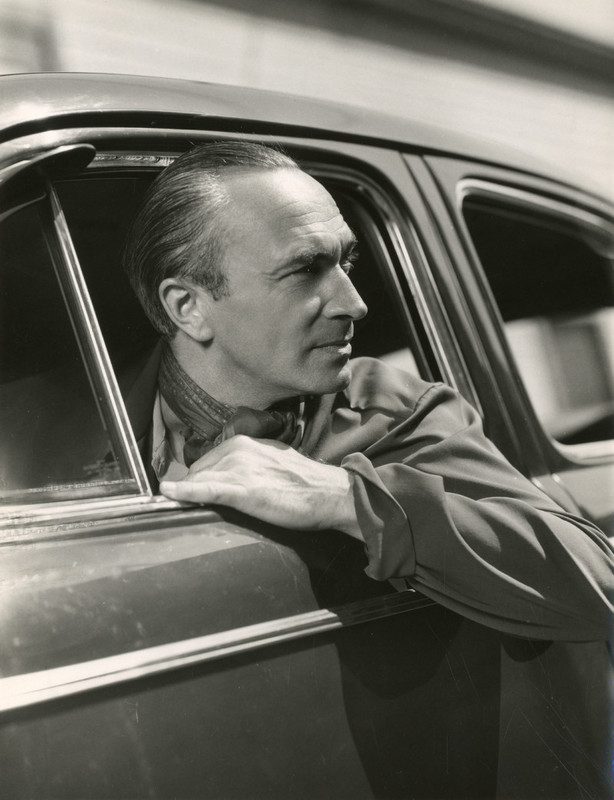
Conrad Veidt, 1940, by Clarence Sinclair Bull

Welcome to the first of a series of posts about Conrad Veidt's work in the United States between 1940 - 1943. I've been wanting to write about this particular part of Connie's career for a while, mainly because there is an underlying sense that the way Hollywood treated him in this period was one of the factors that contributed to his lack of a broader legacy in film history compared to his peers.

Veidt's return to Hollywood was sadly cut short by his sudden death in 1943, but in that time he made eight very different films under the fabled American studio system: Escape, A Woman's Face, Whistling in the Dark, The Men in Her Life, All Through the Night, Nazi Agent, Casablanca, and Above Suspicion. These titles make up the bulk of Veidt's films that one might occasionally encounter on the Turner Classic Movie channel, some of which are better than others for sure. 

In only one of these late career films Veidt was allowed to play the heroic lead. Between 1940 - 1943, his Hollywood contract saw him typecast as six villains, four of which, unfortunately, were Nazis. And none of these roles were close to approximations of romantic leads or love interests as a number of the parts he'd played in the UK in the '30s had been. Regardless, Conrad Veidt infused his 1940s Hollywood roles with complex and subtle, at times verging on subversive, sexuality. The notable exception was of course when it came to his portrayal of Nazi antagonists in All Through the Night, Nazi Agent, and Casablanca.

But Hollywood was uninterested in offering Connie any parts that were particularly challenging. His most memorable roles during this era are the ones he made work through sheer force of will. 

Saturday, February 14, 2026

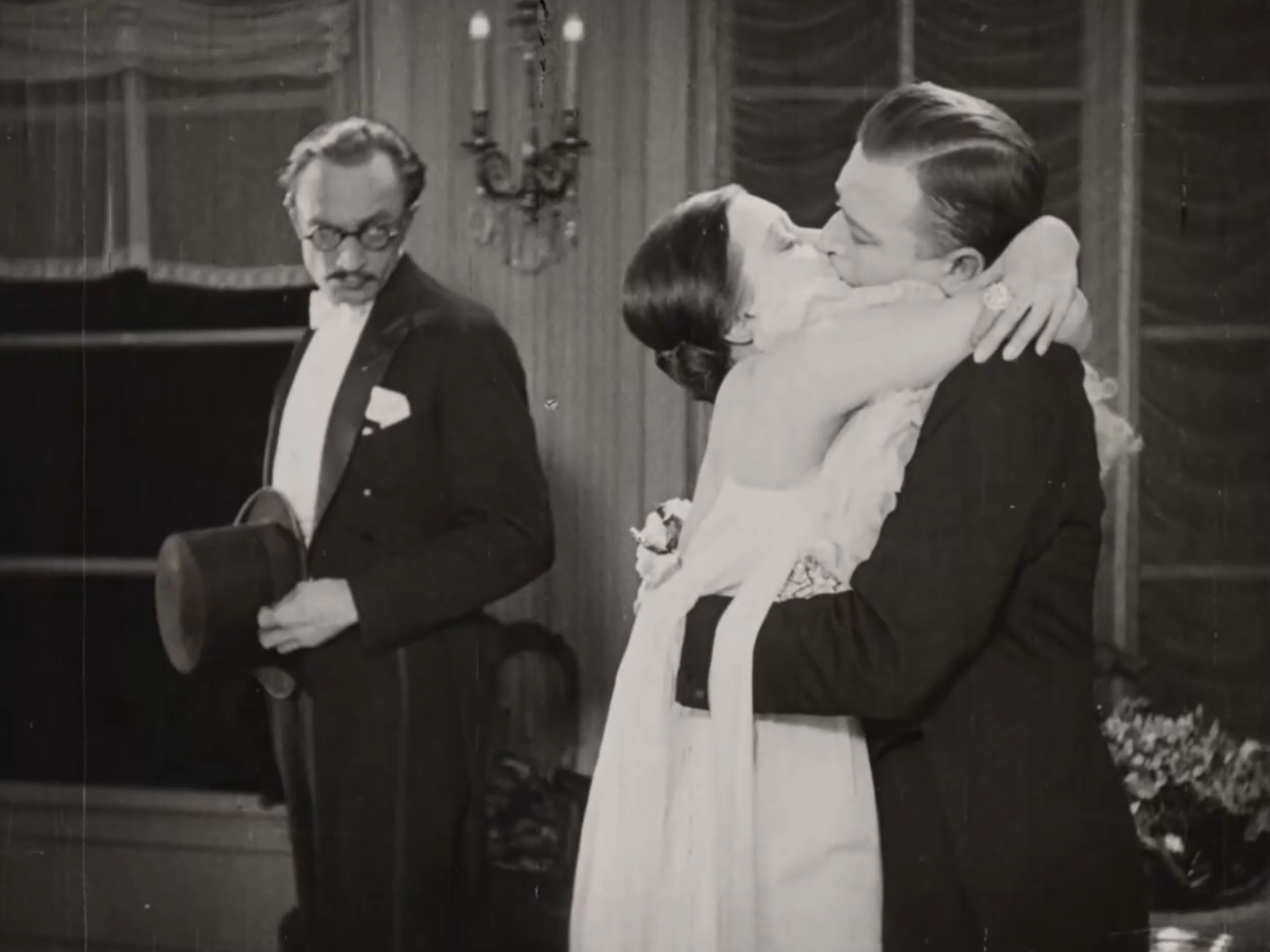
Liebe macht blind, 1925 (A Formerly Lost Film)

Conrad Veidt, Lil Dagover and George Alexander in Liebe macht blind

In the summer of 2025, the Valparaíso Recovered Film Festival in Chile announced that they were planning to screen a newly discovered print of Liebe macht blind, a 1925 silent film previously considered lost to the ravages of time. For the ride or die Conrad Veidt fans, this was a pretty big deal. Of Veidt's 100+ title filmography, nearly half are thought to be lost. The combination of volatile materials, inadequate storage and preservation, and/or the destruction by state or national governments under the guise of censorship and erasure all mean that the vast majority of films produced before 1930 have effectively disappeared off the face of the Earth, or at the very least are in such poor condition that restoration isn't an option. The numbers vary depending on who you ask, but as many as 90% of all silent films could be lost to us.

So naturally, when one of these films resurfaces, it's major news. Over time, one becomes resigned to the very real possibility that you'll never get to see these lost treasures. But when one is found, it feels like a little glimmer of hope, you think maybe there are other gems somewhere out there too.

With Liebe macht blind, it's a rare, and nearly miraculous, case of a complete print being found in relatively good condition. Jaime Cordova, director of the Valparaíso Recovered Film Festival, was lucky enough to come across the 35 mm nitrate print seemingly randomly in Santiago, Chile. This discovery is unique, says Cordova, because Chile wasn't a big hub for cinephiles in the early 20th century the way neighboring countries were. Apparently there had also once been another copy of the film in the United States, but it was reportedly in really bad shape, rendering salvage attempts virtually impossible. Old film is incredibly fragile and susceptible to extensive deterioration, but thankfully there are a number of archival institutions working with prints and fragments of existing films, such as Mexico's Cineteca Nacional where Cordova sent his copy of Liebe macht blind

Thursday, January 22, 2026

Conrad Veidt: A Biography


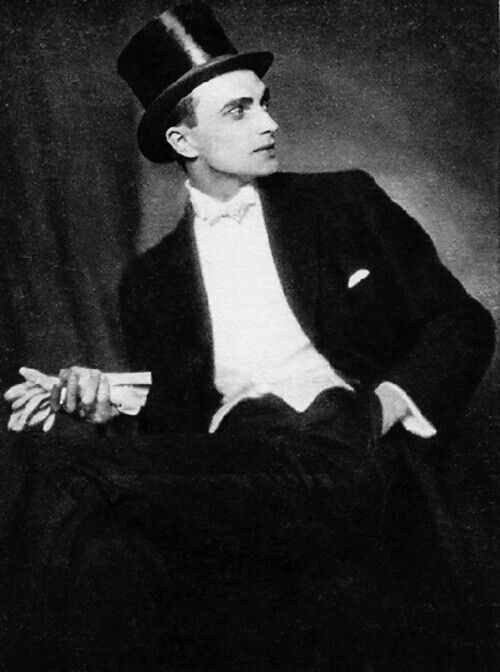
3/4 length black and white portrait of German-British actor Conrad Veidt, circa 1920, in white tie formal wear and top hat, seated in front of a curtain and holding a pair of white gloves in his right hand, his left hand in his pocket, looking off camera in profile to the right
Conrad Veidt, c. 1920, by Karl Schenker

Hans Walter Conrad Veidt, affectionately nicknamed Connie, was born 22 January, 1893. There is some discrepancy regarding the exact location of his birth, but it's likely he was born in a residential area of central Berlin. His parents, Phillipp Heinrich Veidt and Amalie Marie Anna (née Göhtz), were members of the late 19th century's ever-growing middle class. They had one other child besides Connie, a boy named Karl, who died at the age of nine shortly after the turn of the century. Herr and Frau Veidt sent their son Connie to school in Schöneberg where, even though he struggled in school and had terrible grades, he briefly imagined himself going into medicine before finally discovering theater in his late teens when he received high praise for his performance in a Christmas school play. Connie technically left school without graduating, but it didn't matter. By then, he was determined to begin his career as an actor. 

One of the most prestigious theaters in Berlin was Max Reinhardt's Deutsches Theater. Connie had resolved to attend as many performances there as he could, absorbing the work of the great actors of the early 20th century from the cheap seats. His parents didn't always have the income necessary to fund Connie's trips to the theater, but his mother made sure to have some extra cash on hand to support her son's newfound passion. Connie and his mother Anna doted on one another and were always very close. His relationship with his father was more chilly. Phillipp, a civil servant who died in 1917 right as Connie's stage career was taking off, was fairly conservative. Connie confessed years later that his choosing to work in the arts had been a significant disappointment to his father. But Anna loved her son without exception. Her death in 1922 was profoundly devastating to Connie, and he would go on to say candidly that he never really got over it. 

Throughout 1913, Connie spent a lot of time awkwardly hanging around the Deutsches Theater and eventually befriended a staff member who was able to introduce him to a member of Reinhardt's company. This actor offered training sessions and, for a small fee, took Connie on as a student. After several sessions, Connie finally auditioned for Max Reinhardt, performing monologues from Faust. Despite being so green, he must have made an impression, because he received a contract shortly afterward. Connie was over the moon, but his happiness was cut short by Germany declaring war in 1914. 

Sunday, January 18, 2026

Introduction

Welcome to Villain by Accident, a blog about 20th century German-British actor Conrad Veidt.

The title of this blog is borrowed from a June 1941 article by Betty Harris for Modern Screen magazine, which can be read in full on the Internet Archive.

DIRECTORY

About
Here you can find a more detailed introduction about Veidt, this blog, its intended purpose, the writer and their hopes and dreams for this space.

Filmography
A near-exhaustive list of Conrad Veidt's films with the titles available to the general public marked in bold. A living document, films previously thought lost or only accessible through private collections are still being released every so often.

Timeline -- Coming soon!
Important dates and events.

Resources
A collection of links, book titles, and more. To be updated regularly. 


Thank you for visiting, more coming soon I promise!