
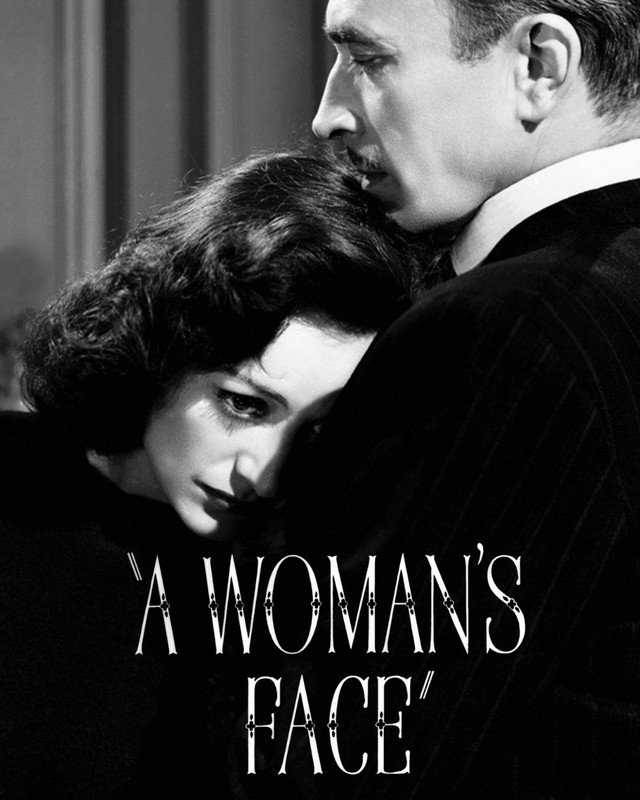
I play the greatest meanie in the world. I befriend a girl who has never had a friend, and then, when she falls desperately in love with me, I try to make her the instrument of a terrible vengeance against my fate. If only I can make people feel this man, this spirit of evil, is an unhappy human being. Sick with unhappiness, the unhappiness of Lucifer, the angel cast out of heaven. If I can do it as I see it, other unhappy people will feel they're lucky by comparison. And even happy people will have a little sympathy for him.
- Conrad Veidt, "Villain By Accident" by Betty Harris, Modern Screen, June 1940
---
A Woman's Face is a strange film. In some ways it's very ahead of its time, while in others it tips into the realm of what director George Cukor called "conventional melodrama." The story itself doesn't really make a lot of sense, but the film does work as a challenge for its actors, especially Joan Crawford, and because Cukor clearly had a unique sensibility that translated a weird and somewhat soapy plot into a relatively layered and complicated film.
Conrad Veidt reportedly called his character, the villainous Torsten Barring, "Lucifer in a tuxedo." Torsten truly embodies the fallen angel's narcissistic ambition and sadism. No stranger to playing infernal bad men, Veidt had played the Devil himself twice in the silent era (Satanas, 1919; Kurfürstendamm, 1920) and Barring is repeatedly described as satanic in almost every review of the film. It's an almost camp performance that somehow still reminds us that Torsten is all too human, perhaps uncomfortably so.
For me, A Woman's Face was the point of no return early on in my initial deep dive into Veidt's work. This film is genuinely unusual and fascinating, even for a modern audience; from Veidt's and Crawford's masterful work on screen to the implications of the story itself, A Woman's Face stands out from a lot of other big studio fare in the early '40s.
---
Welcome to Part Two of Conrad Veidt in Hollywood, my blog series exploring the films Veidt made under the American studio system in the early 1940s. Part one covered his first film back in Hollywood in over a decade, 1940's Escape, which can be found here.
With the success of Escape, Conrad Veidt became an official contract player for MGM. A Woman's Face was his first follow-up under Louis B. Mayer and saw him working with director George Cukor again, an uncredited co-director on Escape, a project Cukor was originally slated to helm, but MGM passed on him because they thought he wasn't suited to the material. They did however call Cukor in to direct re-shoots and additional scenes once principle photography had wrapped on Escape.
If the character relationships were complex in Escape, A Woman's Face takes it even further. There is a subversive cast over this film, especially for the time in which it was made. Today, the Hollywood films of the 1940s aren’t typically considered overly-complicated, although the trauma of the war and the rise of film noir brought a new psychological landscape to filmmaking later in the decade. A Woman's Face is not noir, though. It's a bizarre, dark little jewel I keep finding myself turning over and over after each subsequent rewatch.
And so, before I get into the film itself, I wanted to briefly address the production standards of the era, namely the infamous Motion Picture Production Code.