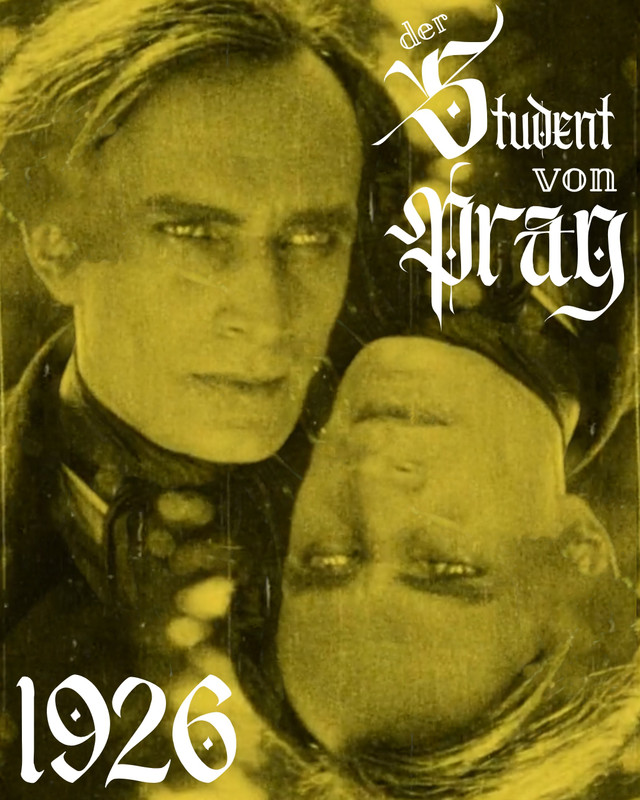
Next month will mark the 100th anniversary of 1926's The Student of Prague, one of the most beautiful and interesting films of Conrad Veidt's career.
A hundred years feels like a long time ago. Probably because it is. But like many silent films, The Student of Prague retains a peculiar timelessness.
Despite being an incredibly successful film in its time, playing to sold out theaters and praised by critics for Veidt's performance and the stunning visuals, The Student of Prague is rarely included in the primary Weimar film canon. Maybe that's because, while technically a genre picture, it's not a textbook example of German Expressionism (although not all German filmmakers were working in that style anyway). Or maybe because, when it comes to directors of Faust adaptations, Henrik Galeen doesn't have the same prestige or name recognition as F. W. Murnau. But I don’t know, maybe some film scholar somewhere can explain this to me one day because the movie I just watched absolutely without a doubt holds its own against classics like Metropolis and The Cabinet of Dr. Caligari.
There is a bewitching quality to The Student of Prague. From Conrad Veidt's dual performances as both Balduin and his Double to the atmospheric cinematography and special effects, it really stands out as a dark and dreamy supernatural period piece.
Veidt considered this film one of his personal favorites and his intense, soul-deep dedication to his leading role is obvious. It's one of my own favorite Veidt performances as well. I first watched this film during the fall of 2023, and something about that memory will forever make me connect The Student of Prague to the autumnal changing of the seasons. I want to live inside this movie. It's one of those films that, in spite of its faults, sweeps me effortlessly into the world of the story.
With each subsequent rewatch, I find myself reacting differently. Previously, I had felt like it was too slow, that the story dragged and the pacing could have been tighter. But this time I really enjoyed that slowness, how it takes its time to not only establish but to savor the spaces between the action. These long takes help to conjure the spell the film casts over its audience, the way Scapinelli weaves his magic to draw Balduin and Margit together.
I also found myself reacting differently to Balduin. On my last viewing, he came off as obnoxious and entitled, whereas this time I had much more empathy and understanding for Balduin as someone subjected to the consequences of bad choices made out of youthful desperation.
This also just to be the first silent film I've covered on the blog (not including Liebe macht blind which I haven't actually seen). Its 100th anniversary has something to do with that. But, frankly, the silent era was a blind spot for me for most of my movie-watching life. But I've really come to respect this era of film history thanks in part to Conrad Veidt. Something interesting happens emotionally and/or psychologically when I watch a silent film. I think about all the people 100+ years ago either behind or in front of the camera, all the hands and minds and eyes that went into making these movies, all the talent and skilled labor and creativity and personalities, the artists who left behind these stories and images. Sometimes I feel like there's something vaguely haunted about silent film. How lucky we are to be able to enjoy the residual artifacts of these people, these ghosts who never knew their work would be so lovingly restored and stewarded into a new century.
---
Der Student von Prag, 1926
Dir. Henrik Galeen
Starring Conrad Veidt, Werner Krauss, Elizza La Porta, Agnes Esterhazy
A tombstone's epitaph reads, "This monument is dedicated to he who gambled with Evil and lost. Pray for the salvation of his soul, you wanderer." The name inscribed: Balduin.
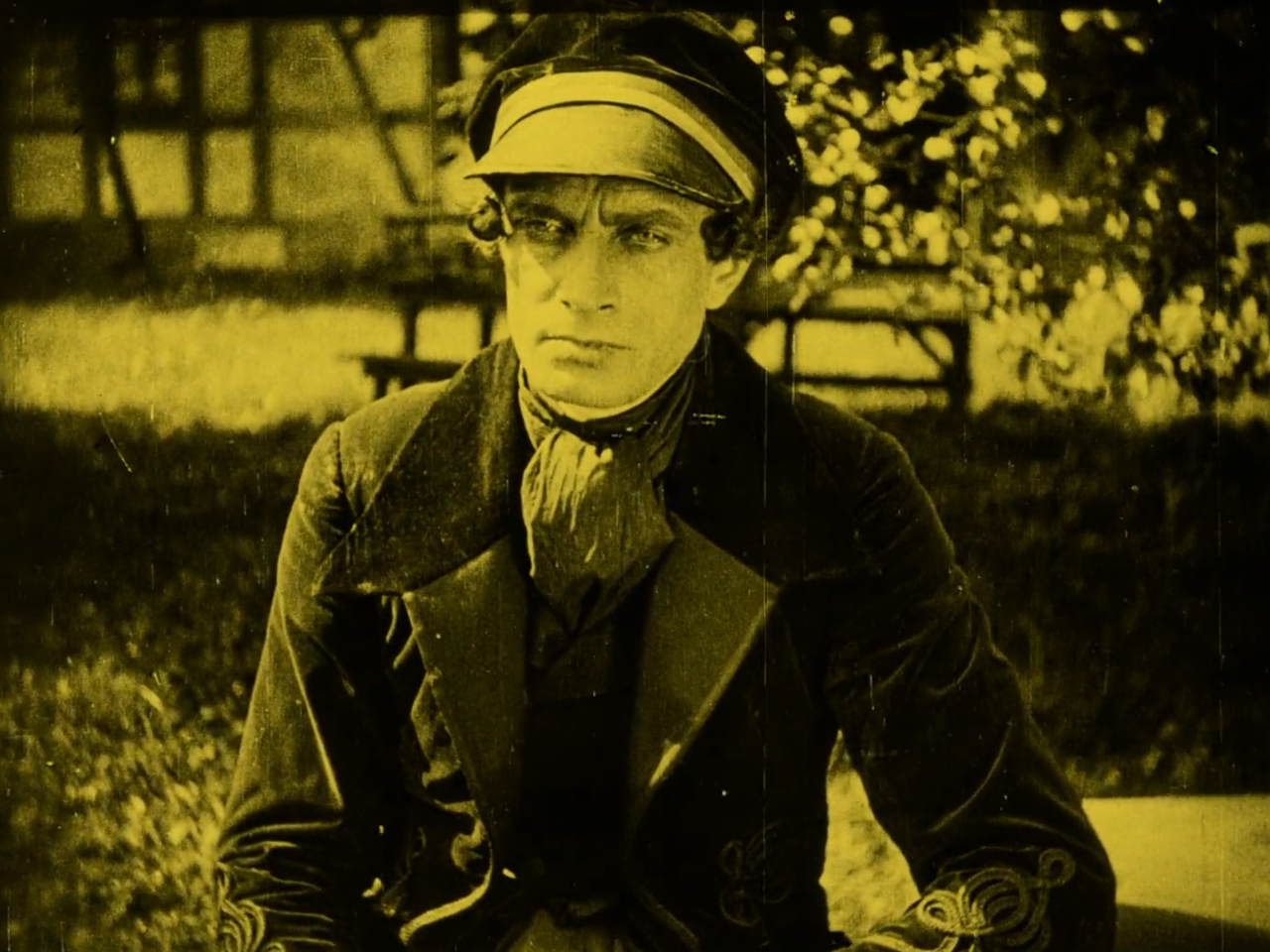
The graveyard fades out into a beautiful countryside scene. It's 1820, and a group of university students descend upon a quaint, pastoral village inn. The boys are mostly merry but there is one who sits apart from the group. Despite being young, handsome, beloved by his friends, not to mention supposedly the best fencer in the whole of Prague, Balduin is troubled. Preoccupied by thoughts of his finances, he isolates himself from the others.
As his classmates travel inside the inn to begin an impromptu fencing match, Balduin lingers behind. But he is not alone. He's approached by a strange man in a tall black hat who calls himself Scapinelli and claims he can help. Balduin, annoyed, only tells the man, "Find me a rich heiress, then I'm your man, " clearly with no expectation that Scapinelli will make good.
Nearby, a fox hunt is just beginning at the estate of Count von Schwarzeberg. The count has just promised his daughter's hand in marriage to her cousin, Baron Waldis. The Count's daughter, Margit, is less than thrilled.
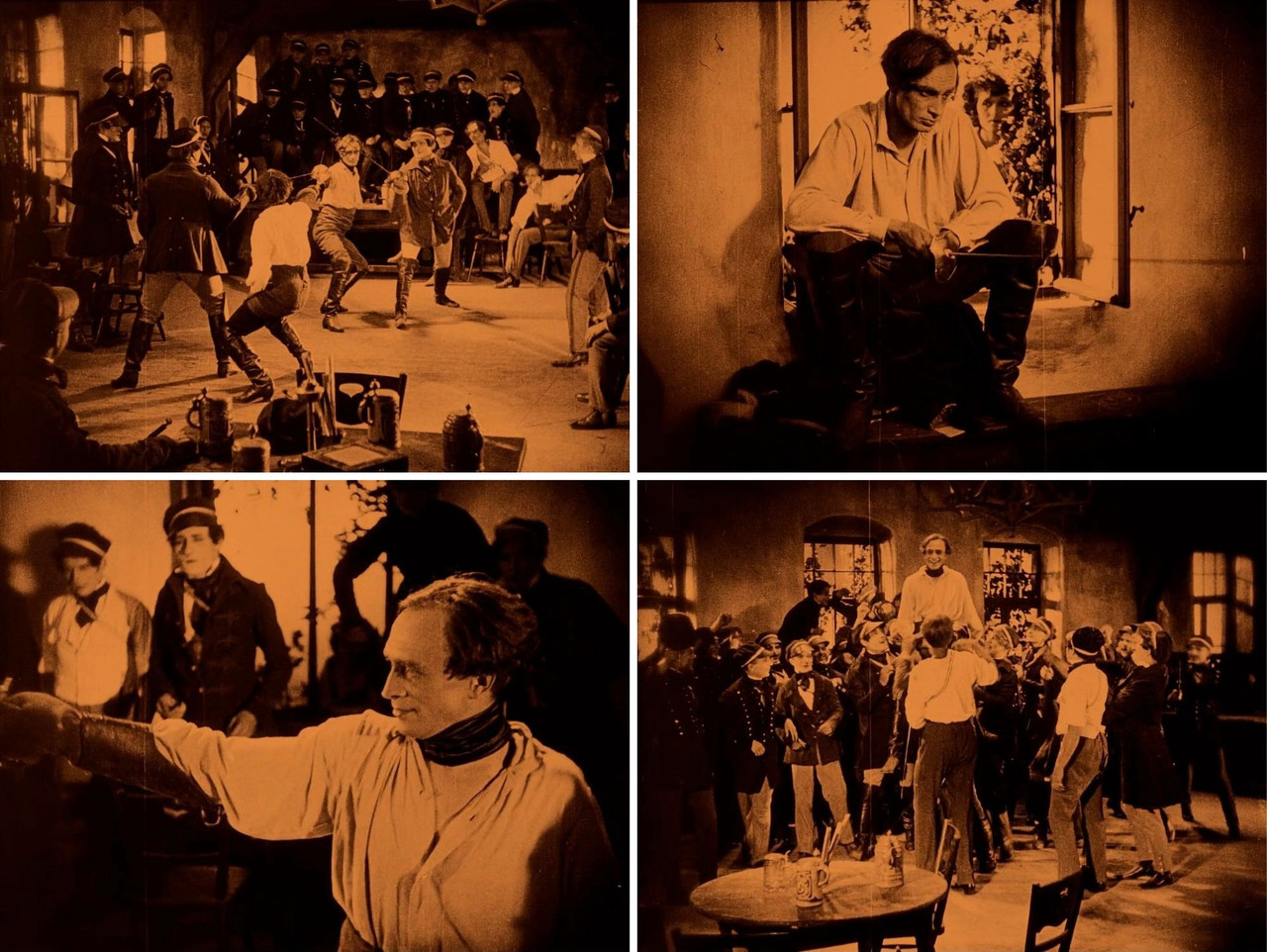
High on a windy hill, Scapinelli begins to weave the two stories together. He draws the fox hunt closer and closer to the inn where Balduin and his fellow students draw swords. It's all a game, but Balduin expertly disarms his challenger, winning the match, carried on the shoulders of his adoring friends. Also making eyes at Balduin is Lyduschka, a young girl clearly smitten with the expert fencer, but he barely sees her.
Driven by Scapinelli's spell, the fox hunt plows through the yard outside the inn. Countess Margit's horse throws her off and Balduin catches her as she topples from her saddle. Their eyes meet, the attraction instant; Scapinelli's trap is set.
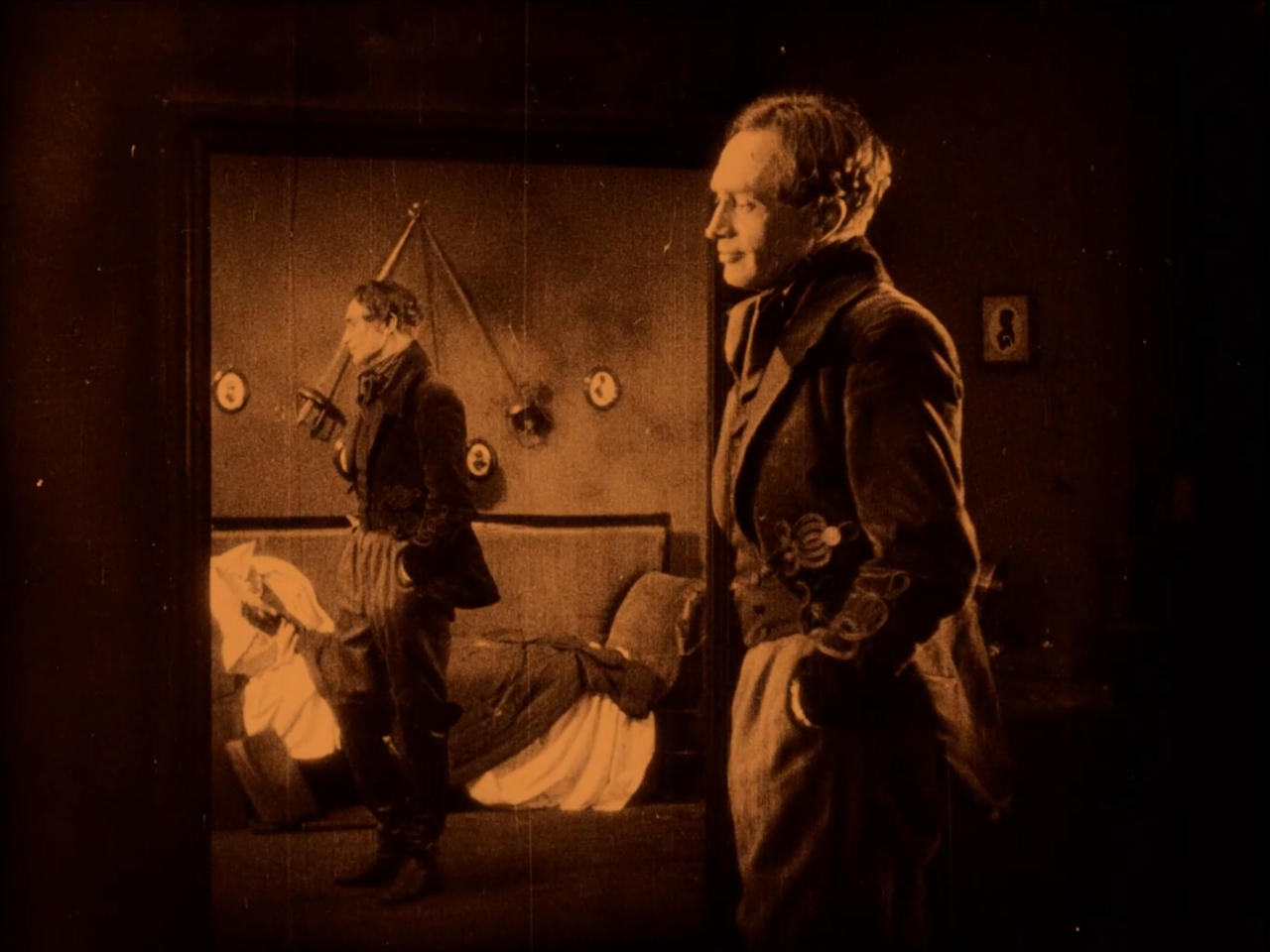
The countess is so far above Balduin's station that he is cast into despair. But the following day, he is visited again by Scapinelli, who produces a contract. It states that Balduin will receive 600,000 gold pieces, an unimaginable fortune, in exchange for one single thing from his room. Balduin looks around and laughs. There's nothing of value in his room, so he signs the contract while Scapinelli leers maniacally over his shoulder. Thousands of gold coins pour from Scapinelli's purse as the young man stares in disbelief. But now Scapinelli must claim his prize. Balduin looks on in horror as Scapinelli summons the student's own reflection from a large mirror. For a moment, the two Balduins stand facing one another. But the Double, now Scapinelli's property, is obediently led from the room, leaving Balduin alone and without a reflection.
Time passes. Balduin has everything money can buy, but he does not yet have Margit. At a recital given by the young countess, he passes a love note to Margit and they meet on the terrace for a brief moment. From below, Scapinelli's shadow reaches up and snatches the note. It falls at the feet of Lyduschka, also spying on the couple. Later, the two lovers meet in a cemetery, but the romantic scene is interrupted by the eerie and threatening presence of the Double. From this moment on, Balduin will know no peace.
Lydushka turns over the love note to Margit's fiancé, and the baron rides out to confront Balduin. Some friends encourage Balduin to challenge the baron to a duel. Margit's father convinces Balduin to back down as he knows the baron will lose the fight. But the next day, Balduin is waylaid before he can meet the baron. He runs as fast as he can to catch him, but he encounters his Double first. Just beyond the trees is a grim scene -- Baron Waldis is dead, killed by Balduin's Double.
Balduin is expelled from the university, his friends turn their backs on him, and he falls into a hopeless rage. Margit refuses to see him, and he goes to a grimy pub to drown his sorrows. Lyduschka arrives as Balduin is drunkenly causing a scene. She manages to get him back to his mansion, but in his drunken stupor, Balduin seduces the girl. Upon waking and realizing what he's done, he runs out into the windy night.
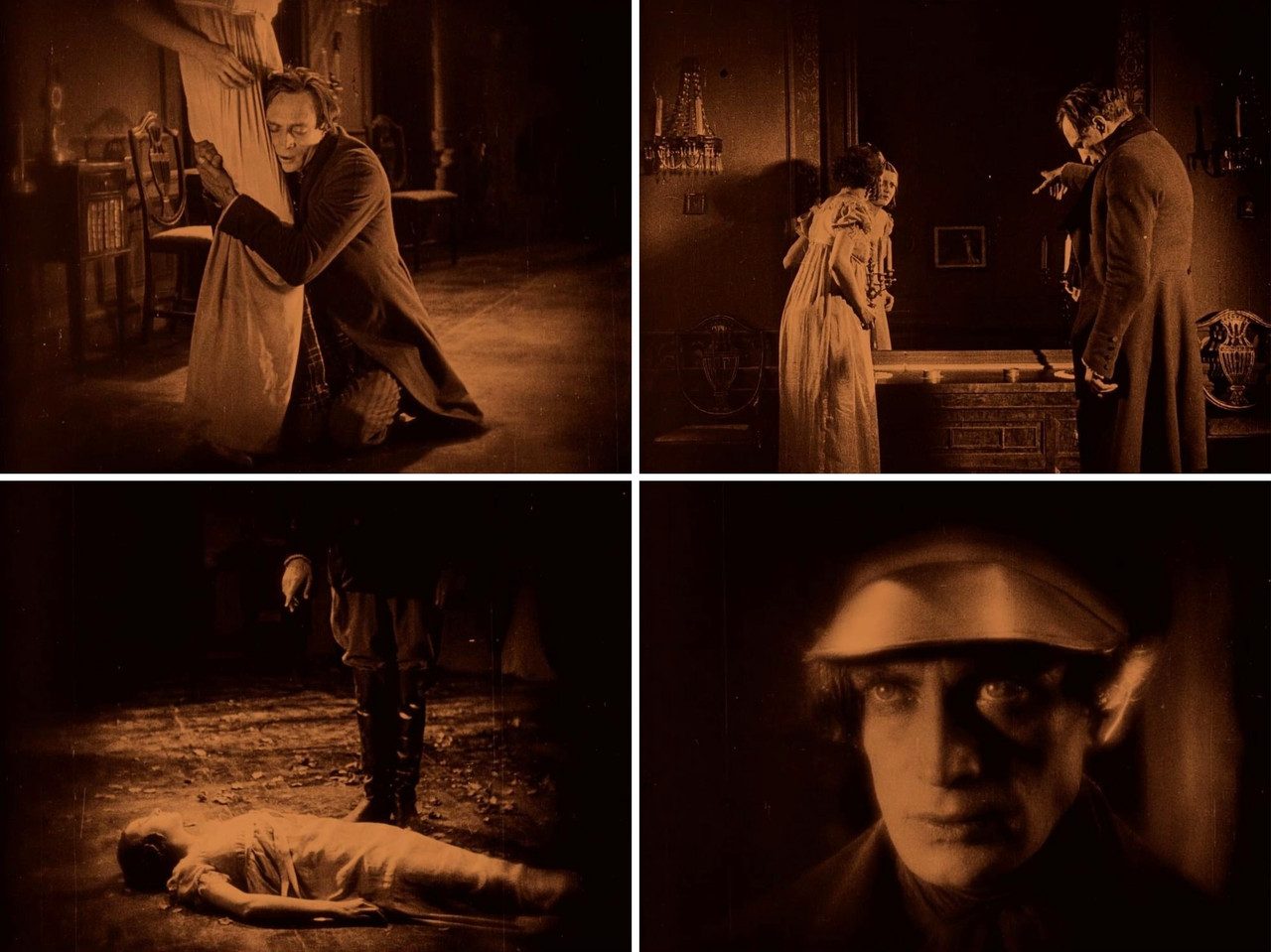
Balduin breaks into Margit's room to explain that her cousin's death wasn't his fault. She rejects him, but he still clings to her desperately, and makes the impossible decision he knows might be his only hope of forgiveness. He pulls her to the mirror and points to his missing reflection. She reacts in horror, fainting just before the windows blow open and the Double materializes between the windswept curtains like a ghost.
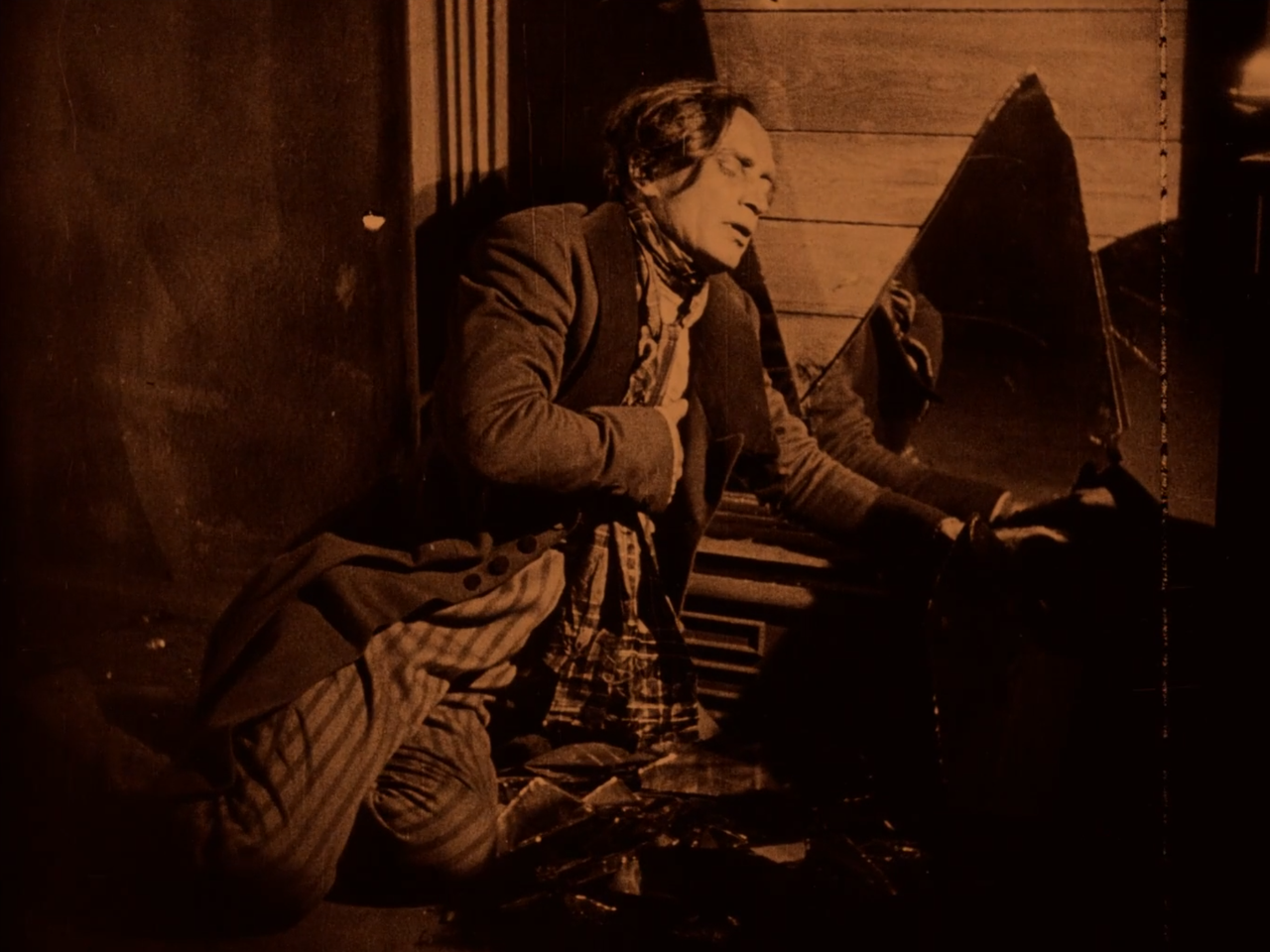
Balduin flees, pursued by his second self through the night and the howling gale all the way back to his old student room. He draws a pistol, the Double daring or perhaps pleading with him to take his shot. Balduin fires and the Double instantly disappears, the bullet shattering the mirror. Balduin falls to the floor, seeing his reflection restored among the shards of broken glass. But it is too late, the shot meant for the Double has killed them both. The wild triumphant smile on his face contorts into a twisted grimace of pain as Balduin dies.
Henrik Galeen's The Student of Prague premiered in Berlin on Oct 25, 1926, and was released just one month after its star left his home country to make his Hollywood debut.
Galeen's version was to be the second of three total eventual films loosely inspired by an Edgar Allan Poe short story and Goete's Faust. The first adaptation from 1913 was helmed by actor-director Paul Wegener who would go on to work with Galeen on Der Golem. The third version from 1935 starred Austrian actor Anton Walbrook who later, like Veidt, fled fascism to establish himself in Great Britain, also becoming a frequent collaborator of friends of the blog Michael Powell and Emeric Pressburger.
As relatively mysterious figure himself, Henrik Galeen must have had some kind of connection to the uncanny, at least creatively. Most notably, he was the primary screenwriter on 1922's Nosferatu, another film that blended the Gothic with Romanticism and Expressionism. But throughout his career in silent film, Galeen often returned to themes both supernatural and macabre. He also penned the screenplay for Waxworks (1924), his only other film starring Conrad Veidt, co-wrote/directed 1915's Der Golem with Wegener, and wrote/directed the very strange Alraune (1928) starring Metropolis's Brigitte Helm. Galeen, like Veidt, Wegener, and most everyone else in the Weimar film business, was connected to Max Reinhardt and Expressionist theater of the late 1910s - 1920s. And despite the enormous success of Der Golem, Nosferatu, and 'Student, his career petered out by the mid-1930s. Galeen's Jewish heritage forced him to leave Germany in the '30s, but sadly he also seems to have left his career in film during this period as well.
Galeen's artistic sensibility gives 'Student much of its eerie magic, but the contributions of cinematographer Günther Krampf and art director Hermann Warm also help shape the look and feel of the finished film. Krampf had brought Galeen's visions to the screen on Nosferatu and had also worked with Veidt a few years before on The Hands of Orlac, and Warm had been instrumental in creating the iconic visuals for The Cabinet of Dr. Caligari. But even with a team stacked with so many German Expressionist heavy hitters, 'Student never really veers too hard into that particular style. I've been calling the look of this film "Expressionist Lite" because it still definitely pulls from some of the exaggeration and heightened emotional affect of proper German Expressionism.
Stimmung:
In The Haunted Screen, Lotte Eisner talks a lot about the German word Stimmung. Today, people might say Stimmung is kind of like "vibes", a word I'm definitely guilty of overusing, but in the context of silent film, Stimmung represents the "musical conditions of the soul". Eisner calls Stimmung "a metaphysical accord, a mystical and singular harmony amid the chaos of things, a kind of sorrowful nostalgia which, for the German, is mixed with well-being, an imprecise nuance of nostalgia, languor coloured with desire, lust of body and soul," something closer to Symbolism than Expressionism.
Stimmung can slow down the action of a film, but it's intentional, a conscious decision to linger on a feeling rather than advance the narrative. A lot of things can contribute to this specific kind of atmosphere: lighting, staging, certain effects, and one could argue certain performances as well. As an actor, Conrad Veidt was always trying to fully embody his environment, absolutely contributing to the somewhat hard to distill feeling of Stimmung.
This mystical, melancholy nostalgia is on full display in The Student of Prague, in the film's desire to be more symbolic and Romantic, more like something created by E. T. A. Hoffmann or indeed Edgar Allan Poe, but wedded to an Expressionist sensibility. I see Stimmung in The Student of Prague in the presence of wind, the quality of light and shadow, and the realism of the natural world juxtaposed with stylization.
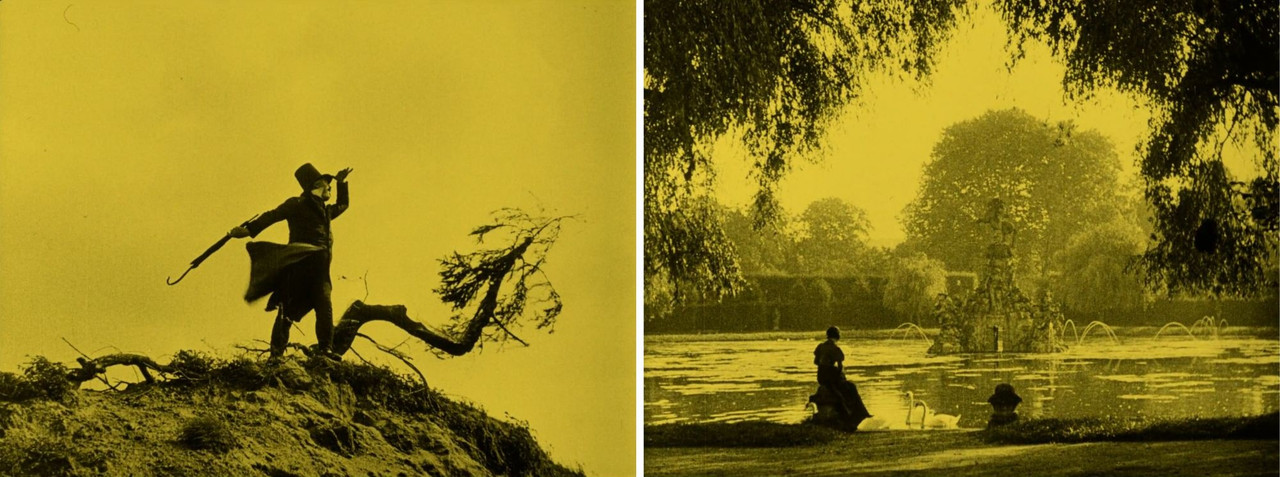
Wind -- The use of wind not only injects air and breath into the film, but often acts as a signal that something supernatural is occurring: Scapinelli's coat billowing out behind him on the hilltop; the rustling foliage behind Balduin after the duel; dry, dead leaves blown into the countess's bedroom; sheer curtains caught in a night breeze; the gales that follow Balduin through the city in the film's final act. Whether on a studio set or in location shots, wind is atmospheric as well as magical, it's Scapinelli's invisible presence even when he's not on screen.
Light -- There is a gently diffused quality to the light throughout the film, making it feel more natural than harsh studio lighting. High contrast light and shadow was essential for filmmakers working in the Expressionist style. But 'Student's early 19th century setting and the outdoor locations (real and fabricated) connect the use of light and shadow here to something more like a fairy tale illustrated by Arthur Rackham. The Munich Film Museum's digital restoration really highlights how successfully Krampf's cinematography implemented value and soft contrast to create a visually rich film.
Like the wind, there's also something eerie in the light. Watch the light catch Balduin's eyes when he first meets Margit. His eyes glow, echoing the brief glow in Scapinelli's eyes earlier in the film. Later, it's mostly Balduin's Double whose eyes are caught by the light, a useful and uncanny effect linking these three characters together.
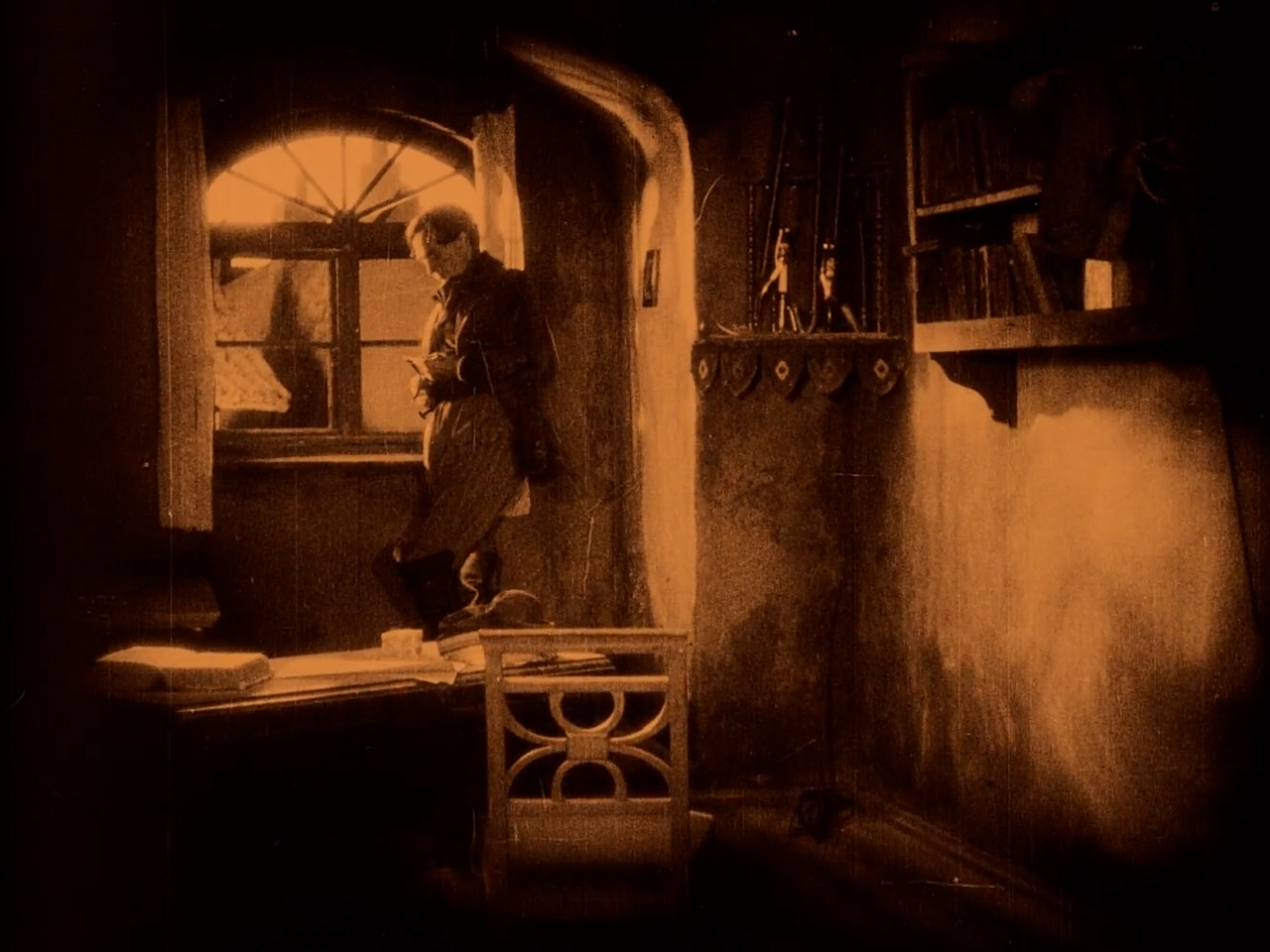
Set Design -- Of the sets Warm built at the Staaken Studios in Spandau, the labyrinthine back streets and the overcrowded cemetery are perhaps the most Expressionistic locations in the whole film. There's a level of restraint to the rest of his design, even in the more opulent rooms, that puts the focus on the action rather than the artist's vision. It's the outdoor scenes that are really important in grounding the film in reality, however heightened. But the use of land and sky also give the film a sense of space, place, and injects some air into what could have been a very claustrophobic film.
Effects:
On my first watch a few years ago, I was struck by the special effects used in this film. The editing trick of having two Balduins on screen at the same time is pretty seamless, especially given the technology they had access to in the mid-1920s (see clip below). There's a moment when the Double appears in an open window. Not only does he fade into the room like a ghost but so does his shadow on the floor, and remarkably this fade occurs in front of curtains and branches wildly caught in the wind. Also check out the moment shortly afterward when the Double seamlessly walks through an iron gate. The overall effect is incredibly impressive even now but probably especially so for audiences at the time.
The camerawork itself isn't super fancy, and I do think the film is better for it. There are only a few iris framing shots, mostly toward the end of the film. Rather, they use vignette framing to soften the edges of the frame, giving the illusion of candlelight or gaslight. One of the boldest shots in the film is used where Connie as the Double, in extreme closeup, zooms backward through Margit's bedroom. Presumably he and/or the camera is on a dolly, reminiscent of the famous dolly zoom in Jaws nearly 50 years later. It's kind of incredible to see something like that in a 100-year-old film.
'Student is tinted in four colors: blue-green for night, rusty orange and pinkish red for interiors, and yellow for daylight exteriors. Notes from the intro to the digital restoration say that the color tinting for this most recent existing version done by the Munich Film Museum based on some of what could be seen on an older print of the film from Spain.
Music:
The relatively minimalist soundtrack, composed by Stephen Horne, really does suit the film. It supports the narrative and mood without being distracting as so many newer silent film soundtracks unfortunately tend to do. The score is mostly piano supplemented by one or two other instruments, a flute or an accordion, and occasionally something that sounds like music box chimes, and thankfully there are only a handful of repeated themes. Unfortunately we don't know what the original soundtrack by Willy Schmidt-Gentner was like. Regardless, the new music definitely feels appropriate not only to the period but to the film as a whole.
The Story:
Co-written by Galeen with Hanns Heinz Ewers, The Student of Prague pulls elements from an Edgar Allan Poe short story titled "William Wilson" as well as Goethe's Faust. The film definitely captures the spirit of a Poe tale, especially in how it plays out at the end. There's a lot of dread and helplessness in the final act that owes a lot to Poe.
The use of the tombstone epitaph to bookend the film is purely for the audience's benefit; we know from the beginning how the story ends. And, as far as we know from the action that follows, Balduin never outright confesses the bargain he struck with Scapinelli to anyone, and no one ever sees Balduin and his Double together. So therefore no one else in the story would have any reason to expect he did something so diabolical as sell his sentient reflection for a chance at love and wealth.
There are a bunch of things in the script that leave me puzzled. First of all, why is no one suspicious about how Balduin suddenly came into all this money? He was dirt poor one day and filthy stinking rich the next, how is that not a red flag for some kind of sketchy behavior?
I also have a lot of questions about Scapinelli. Is he real? Is he only visible to Balduin? Is the whole story made up, did Balduin's personality fracture in some way and is he really doing all the terrible things that his Double is supposedly doing? How does that affect how we're supposed to feel about him? And one can only imagine what Scapinelli is actually doing with Balduin's Double. Werner Krauss's performance is very Expressionistic and over the top, so much so that I'm not sure what to make of it. He plays Scapinelli as more of a creature than a person. He's also super gross, the way he leers at Balduin and holds his money purse at crotch height when he pours out all the gold coins is extremely uncomfortable. It's worth mentioning that Krauss was an antisemitic dirtbag so there's probably some xenophobia informing his performance too.
It's odd that they reused a shot of Scapinelli at the very end, because he doesn't have any other on-screen scenes after about the midway point of the film. It's like the story didn't really need him after he took Balduin's reflection from the mirror, but perhaps Galeen wanted to remind the audience that Scapinelli was working behind the scenes, so to speak, the whole time.
I've also been stumped about how old Balduin is supposed to be. I believe the students are supposed to be in university, which might mean they're in their late teens despite all of them looking much older. And why is Balduin so broke? Maybe he actually is older and stuck at university because fencing is the only way he can support himself. There are a lot of unknowns, and while they may keep me up at night they're not really important to the narrative or action of the film.
It is interesting that 'Student has something to say about class disparities. Balduin may be a lazy youth, but deep down he knows the only way out of his money troubles is through marriage, and the chances of him marrying above is station are extremely unlikely if not impossible.
This film marks a really interesting moment for Conrad Veidt as an actor and as a movie star. It's maybe the best example we have of his appeal, the thing that made him an object of desire for audiences. His performance and the way he is styled is so specifically attractive in a way I have yet to find his equal to in the silent era.
Paul Ickes wrote about Connie being part of a new tradition of European-German masculinity and lumps him in with actors like Emil Jannings. The point Ickes was trying to make was that male German movie stars of the 1920s didn't have a place within Hollywood's vision of the ideal man of the silent era, the Rudolf Valentinos, the Ramon Novarros, etc. But I respectfully disagree. What is European-German masculinity of the 1920s anyway? Is it just a type of continental, refined gentleman? I would argue that Connie actually is more like Valentino or Novarro than he is like Jannings or any of his peers in Germany. Connie was attractive in a dangerous way because of his explicit androgyny and unconventional beauty, and that aligns him more with those two specific Hollywood stars. Connie could play romance just as well as Valentino or Novarro, but his Deutsches Theater training gave him more range as an actor.
Elizabeth Otto absolutely gets it right in her essay, "Schaulust: Sexuality and Trauma in Conrad Veidt's Masculine Masquerades". Connie, especially in The Student of Prague perhaps more than any other film he made in the '20s, is "attractive, strong, and masculine yet soulful and haunted." He is an androgynous anti-hero, Romantic in the Byronic sense, presented as someone to be desired because of his darker qualities. Otto writes, "[Veidt] is far from the marriageable type, and thus, as in previous roles, he offers the stuff of fantasy without compromising the newfound freedoms of New Woman viewers." And I would add that there are explicit queer undertones in 'Student; Scapinelli lusts for Balduin more than any other character in the film. He is designed to be a sexual object for everyone, not just heterosexual women.
One skill that Connie had that a lot of his peers lacked was his ability to project intimacy through the screen. This had to have been something he carried over from his years on the stage, but on camera and especially in close up he's able to take that intimate quality even further. Galeen's camera captures Connie's expert control over his expression, something he utilized throughout his career. But because Balduin is tragic and Romantic and dramatic, he can use all these varying levels of control over his performance in closeup shots.
Balduin is truly a groundbreaking role for Conrad Veidt at this time in his career. This film alone must have signaled to producers that he was more than ready for his meatier and more interesting roles of the late '20s. As Balduin, Connie was free to play big when it worked for the character, but also incorporate all these incredibly subtle and vulnerable moments as well.
Connie was in his 30s when he made this film and he does the best he can at playing much younger. He plays Balduin as foolish and naïve in the way only someone very young can be. His youthfulness isn't just suggested in the character's decisions but also in his physicality. When we first meet Balduin, he's sulky, pouty, and petulant. He has this slouch that says so much about the character, it shows his youth, his station, his whole attitude. But around the countess, his posture changes, his back is straighter, his shoulders more square. Connie was also a master of hand acting, watch his hands in any given scene, he does just enough to draw the eye even in a wide shot. His fully embodied acting style allowed him to genuinely use every part of himself as part of the performance.
In the first act, he's clearly beloved by his fellow-students and he easily slips out of his misery about his money problems into a more lighthearted mood. He's moody one moment and playful the next, joining in a low-stakes fencing match for fun when moments before he was brooding alone in the garden. This early lightness about him sets him up for his eventual inevitable hard fall into shame and helplessness.
In the fencing scene, Balduin looks apathetic at first, but he comes alive when the match starts. He clearly loves it and knows how talented he is, and he easily disarms his opponent three separate times. (See this Tumblr post for more about this scene, they get into the technique and style of fencing used in the film.) A lot of the other students have facial scars from past fights, but Balduin's face is notably unmarked which goes to show how much of an expert he clearly is. His swordsmanship is what inevitably seals his fate, but in the end it cannot save him.
Admittedly, Balduin isn't 100% likeable. His scenes with the little flower seller, Lyduschka, are difficult to watch. She's so desperately obsessed with him and he barely gives her the time of day. Early in the film, he lazily runs his hand over her hair but doesn’t even look at her. And when her dress is torn by a different student, Balduin challenges him to fence but not because he cares about Lyduschka, he only does so because it's proper. He only finally accepts Lyduchka's affection when he's at his lowest, going as far as to sleep with her but reacting with disgust and anger immediately afterward. But I don't think Balduin's final reaction to Lydushka is personal, she's just a reminder of his true low class status.
His scenes with Margit on the other hand are the embodiment of sensual Romanticism. I think Balduin really does love Margit, or at least thinks he does. But she would also be the means to ensure his ascent out of poverty even if something should happens to all the gold he received from Scapinelli, further complicating their relationship. The way Connie plays the love scenes between Balduin and Margit is full of deep, hungry yearning. Agnes Esterhazy as Margit is all dreamy romance, whereas he is very grounded and present and physical in his affection towards her. The choice to stage their main love scene in a cemetery where Balduin's Double watches from the shadows certainly marks them as doomed lovers (see Clip 02 above).
Veidt's performance as the Double is absolutely fascinating. We only see this character four times before the last act of the film. Initially when the reflection steps out of the mirror, the Double seems pretty soulless. His dead-eyed, mask-like expression as he stalks out of the room makes it seem like he's just going to be a mindless puppet Scapinelli can use to torment Balduin. And certainly in their first two encounters, the Double slinks out of the shadows as a reminder of Balduin's Faustian bargain but also as something of a stand-in for his conscience. The first two times we see the Double out in the world are when Balduin is at his happiest, in his most romantic moments with Margit, a woman not only completely out of his league but also who has been promised to someone else. Nothing about the Double's presence in these scenes suggests that he's anything more than a phantom, a specter to haunt the protagonist from a distance.
But then something changes. The Double isn't a ghost that only Balduin can see, he's just as real as his counterpart, and his actions have consequences. Balduin promises Margit's father, the Count, to spare her fiancée in a duel the Baron knows he cannot win -- Balduin is, after all, the best swordsman in Prague. But when the day of the duel arrives, Balduin is delayed by the wheels inexplicably coming off his carriage. He races through the countryside on foot in order to make his appointment, but it's too late. He stops dead in his tracks, frozen in fear, as the Double appears, approaching him slowly from the tree line. When the Double reaches him, Balduin sees the bloody sword and fears the worst. But what's most interesting about this scene is that, when the Double finally looks up, his expression is not that of a mindless zombie. Realization slowly rises in the Double's face, and he turns to Balduin with this look of abject horror and helplessness while Balduin cowers in terror. As the Double turns to walk out of the clearing, he hangs his head in pained resignation. There are no intertitles in this sequence, but the anguished look he gives Balduin says, "Do you see now? This, and worse than this, is going to keep happening because of what you did." Connie's performance in this scene suggests the Double may not be able to control his actions but he certainly has feelings about them. (See this scene in the Clip 03 above.)
The Double is also consistently dressed in the student uniform Balduin wears at the beginning of the film. After Sciapinelli gives Balduin the money, Balduin buys a whole new wardrobe to match his newfound wealth. But the Double doesn't change to reflect Balduin as he is in the present. The Double wears the clothes of a student -- the cap, the jacket, the boots -- because he represents who Balduin was. He's the boy, the youth uncorrupted by excessive wealth and privilege, now made to do horrible things because Balduin so easily handed him over to Scapinelli when they made their deal.
The Double also never speaks, there are no intertitles for him. He communicates everything with his expression and body language. Connie plays the Double in a more "histrionic" style, as defined by the two main modes of silent film acting discussed in Rebecca Swender's "Problem of the Divo: New Models for Analyzing Silent Film Performance" (Journal of Film and Video 58.1-2, Spring - Summer 2006). This style calls to mind Caligari's Cesare, especially in the way he consolidates his movements so that he practically glides through the frame. The way Veidt keeps this performance distinct by slowing everything down and using anguish and judgment to contort his expression gives the Double a quality of being not-quite human, more dream-like and surreal. Later, Balduin himself starts to adopt some of this contorted physicality after he reveals the truth to Margit, his shame and guilt transforming him as his performance becomes more Expressionistic.
The final time Balduin sees his Double, his mirror-self hounds him with measured steps, pushing him away from the fragile security of wealth and opulence back to his abandoned student flat. The two closeup shots of Balduin at his front door with the wind in his hair show that he knows how doomed he is, and yet he runs anyway. The expression on the Double's face now is grimly accusatory, it's deeply solemn disappointment, a final judgment before the inevitable end. There's sorrow and resentment in the Double's haunted eyes, kept restrained and subtle, gradually building in wordless intensity until Balduin must finally face himself, literally, in order to end his torment, finding a pistol and shooting his mirror image and therefore ending his own life.
It's not clear how much of the Double's actions at the end are being controlled by Scapinelli who is notably absent from most of the second half of the film. If the Double has any autonomy at all, does he solely use that agency to remind Balduin that he must pay for his discretions, his greed and sacrilegious behavior? Does this therefore mean the Double is in fact Balduin's soul? The Double in The Student of Prague is emblematic of the Kill Your Double trope in that a part of Balduin's self has already been sacrificed even before the final shot is fired. Balduin's youth and innocence have been perverted into a murderous force just because he dared to desire a life above his station.
Does that make The Student of Prague a cautionary tale? I'm not completely sold on this idea. There is a fairy tale "be careful what you wish for" message to the film, but ultimately the finished product is more of a tragedy mixed with the unsettling nightmare of doppelgänger horror.
---
If you would like to watch The Student of Prague in honor of its centennial anniversary, and I highly recommend that you do, the Filmmuseum München digital restoration is available on The Internet Archive with German intertitles only. It is also available with English subtitles from this masterpost along with many other Conrad Veidt titles. I don't recommend the version on Youtube as it's missing nearly 45 minutes of footage and the quality is much poorer.
And for those of you like me who covet physical media, The Student of Prague did receive a new Blu Ray release last year from Deaf Crocodile with new cover artwork in a two-disc special edition with Henrik Galeen's Alraune, available here.
---
RESOURCES
- Conrad Veidt on Screen, John T. Soister
- Ein Buch vom Wesen und Werden Eines Künstlers, Paul Ickes
- The Haunted Screen: Expressionism in the German Cinema and the Influence of Max Reinhardt, Lotte Eisner
- "Schaulust: Sexuality and Trauma in Conrad Veidt's Masculine Masquerades", Elizabeth Otto, The Many Faces of Weimar Cinema: Rediscovering Germany's Filmic Legacy
- "All The World's A Screen", B. Curtis Brown, The Graphic, 7 May 1927

No comments:
Post a Comment